Episode 4: Monsters: from Individuals, Eccentrics, Weirdos, Monsters, Pests, Creeps, and Alfreds.
- purple_peril_
- Oct 20, 2022
- 10 min read
Updated: Sep 15, 2024
[...continued]
Well, at least I’m not turning into…
A Monster
Rachel Redfern (1) saves me! Redemption! Thank God; she asks me about my suit. Phew! A reprieve.
‘Oh, thanks. Yes, the flowers are from an art nouveau Aubrey Beardsley design.’
I’m particularly indebted to Rachel because she kick-started my post-pandemic dancing this year at March Torture Garden. I can thank her for that! Yes, I can talk about that…
But, during this conversational on-yer-toes-micro-pre-planning, I notice people in the group have reconfigured their places in the foyer: Iris’s pal number one politely introduces Iris to Rachel, and I’m standing right in the way.
I’m right here! I’m bang in the line of vision. Do I move? Do I swap places? Do I retreat? Do I casually disappear? Do I change from solid to liquid to gas? Do I pray that a portal opens from a Lovecraftian universe to swallow me whole, never to be seen again?
‘Do I dare disturb the universe (2)’?
Frozen (3).
I know. I’ll wheel around and introduce myself to Iris’s pal number two!
‘Oh, good evening. I thought it would be a terrible discourtesy of me not to introduce myself, I’m Mister Peril. And you are? (4)’ Now, she does look a little surprised at my formality: we are not, after all, attending the Queen’s funeral, we’re in an avant-garde fetish club. She answers. But I only catch the sound of vowels underneath the pulse of Goth-techno. I can’t pick out the consonants.
‘Oh, would you mind repeating that?’ – nope, still didn’t catch it – and this is one of those moments when you just can’t ask for someone’s name again (5).
The name sounded Spanish. Maybe begin a new conversation on the basis of this hunch? Find some common ground! Yes, let’s talk about Lazarillo de Tormes and the Spanish Picaresque tradition. Try that! In a Goth club, that’s bound to oil the wheels of conversation! And, just as I’m winding-up the wit (6) of my verbal galvanic battery; just as I’m about to mellifluously enunciate the first prefix of the first word; I suddenly notice some feint white cosmetic highlighting on the tip of her nose and feint freckles across her cheeks which are so fetching I have a brain seizure.
A complete loss of motor-sensory coordination.
In slow motion, I realise my jaw’s ability to produce the most simple of words will only result in the spluttering vegetative noises (7) of Frankenstein’s monster, and those noises are likely to be far more haunting than the Goth-techno emanating from the room behind.
‘Aghh ughrr eeiiigh oouughhr…’
Be silent (8).
How should I begin? (9)
Don’t attempt to talk.
With any attempt to talk, please know, and know - your inarticulate cries will put the DJ off their (10) stride.
…
Let’s change navigational course and set sail. Let’s chat to some of the twenty-somethingsters (11). I welcome the fact that some of them began talking to me. Me? I suppose being an old-timer who’s wearing psychedelic rubber flowers might be a bit of novelty.
There’s a young woman wearing those great-Goth-contact-lenses that look as though they’re looking the other way compared to where they’re looking. That’s eerily cool. Would be kinda erotic if I had some more -----. I’ve instantaneously developed a new fetish (12). Thank God I came out tonight! She compliments me on my suit. Maybe she’s complimenting someone else? She seems to be looking the other way. Maybe.
Anyway, some of this lot actually like me. (13)
Wraith Club punters view me as a poor, benign, abandoned monster. In their eyes, I’m an orphan.
I’ve become a literary archetype!
I’ve regained posture. Stature (14), even.
…and this lovely lot are Ariels, with their sounds and sweet airs (15).
I shall defend them. I shall praise them. The encomium (16), if you please:
and then in dreaming,
The clouds methought would open, and show riches
Ready to drop on me, that when I waked
I cried to dream again (17).
…
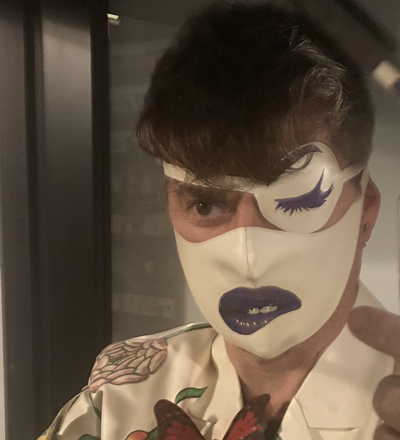
Just been snapped by Darren Black (18).
Darren, by the way, knows the art of the conversational deferral.
‘Hey Darren, shall we talk about that photo-shoot thing for my web-site?’
‘Ok, let’s have a proper conversation next week!’
Darren’s working.
His response is the spoken-mode equivalent of the Marnie Scarlet (19) ‘holding e-mail’ phenomenon-thing. These are very busy people (20). I appreciate that. Receiving the holding e-mail deferral thing is actually very nice, considering the circs (21).
Aphrodaveth11 also knows the gentle art of extrication, by using the extra-contextual, ‘Ooh, I think I might go for a cigarette’ comment.
These three know the rules of how to politely escape from me.
There is a danger I’m becoming…
A Pest
I like creative people. I’m living vicariously, you see. I need to - because I’ve entirely squandered my intellect, talent, hard work, and energy on gaining unnecessary qualifications and leaving illegible scribbles on a broken chalkboard…
[to be continued, rhizomatically…]
A Monster: Footnotes
1. Have you ever noticed that the name Rachel Redfern has the same trochaic rhythmic structure as the name Robert Redford? The very same. You’ve haven’t? Well, what on earth have you been doing with your time? If you haven’t even noticed that then I dare say it’s probably unlikely that you’ve rewritten William Blake’s poem, The Tyger, thus:
Rachel Redfern burning bright,
Robert Redford in the night,
What eccentric ear or eye,
Dare frame thy rhythmic symmetry?
To be honest, my re-writing makes you wonder what William Blake was doing, dicking around with:
Tyger, Tyger, burning bright
In the forests of the night,
What immortal hand or eye
Could frame thy fearful symmetry?
Wasting his time, probably.
2. T.S. Eliot, ‘The Love Song of J. Alfred Prufrock’, from The Poems of T.S. Eliot, eds. Christopher Ricks and JimMcCue (Faber and Faber: London, 2015), pp. 5-9. [Return]
3. I was intrigued to find that the lexeme ‘foyer’ has connotations of warmth in French, hence the stylistic change to this synonym from 'entrance hall' used a few sentences before. [Return]
4. I’m embarrassed to say, that I did actually say this. No embellishments here.
5. I still don’t know her name. My excruciating sense of embarrassment has prevented me from asking ----- ----- directly. [Return]
6. The Tempest, 2.1.13, 2nd ed., ed. David Lindley, (Cambridge University Press: Cambridge, 2013). [Return]
7. 'Vegetative noises' is technically accurate in Child Language Acquisition theory, referring to the first stage of the pre-linguistic noises all babies make in preparation for uttering their first word. These stages are: basic biological (or vegetative) noises, cooing and laughing, babbling (both reduplicated and variegated), vocal play, and then melodic utterance. See David Crystal, Listen ot Your Child (Penguin: Harmondsworth, 1986). [Return]
8. The Tempest, 4.1.59, 2nd ed., ed. David Lindley, (Cambridge University Press: Cambridge, 2013). [Return]
9. T.S. Eliot, ‘The Love Song of J. Alfred Prufrock’, from The Poems of T.S. Eliot, eds. Christopher Ricks and Jim McCue (Faber and Faber: London, 2015), pp. 5-9. [Return]
10. Long before the third person plural pronoun was used to denote non-binary gender identity, it was used as a singular pronoun to solve the problem of gendering a noun of indefinite gender e.g. 'Every person... recovered their liberty'. I'm glad that the use of 'their' to denote non-binary identity has reinforced this change of use, in face of the outraged cries of petty people who claim to know what 'good' English is yet consistently reveal their lack of knowledge of historical linguistics.
Grammar 'purists', or what modern linguists refer to as 'Prescriptivists', demand that 'their' can only be used as a third person plural pronoun, viewing any other uses as 'incorrect'. Their view that the syntax of English is somehow static over time and one that does not vary according to region is, of course, bare-faced idiocy in the view of basic historical facts. Purists also encounter a problem that many great writers such as Goldsmith, George Eliot, Bernard Shaw, have quite happily used 'their' to avoid gendering a singular noun.
Virtually all professional linguists working in University Departments are, thankfully, 'Descriptivists' and appreciate that langauge changes over time including how conventions surrounding the syntax of Standard English. The frequency of use of 'their' as a solution to not denoting gender was further galvanised by Feminist Linguists and publishers. The feminists have won this one, and, thank God!
The most accessible books that demythologise the erroneous views of ‘Prescriptivists’ are Language Myths, ed. Laurie Bauer and Peter Trudgill (Penguin: Harmonsdworth, 1998); the gloriously entertaining Bad Language, by Lars-Gunnar Andersson and Peter Trudgill, (Penguin: Harmonsdworth, 1990); Language Change: Progress or Decay?, by Jean Aitchison (Fontana: London, 1981); Casey Miller and Kate Swift The Handbook of Non Sexist Writing (The Women’s Press: London, 1985), pp. 44-62 on the pronoun problem; Dwight Bolinger’s Language: The Loaded Weapon (Longman: Harlow, 1980), pp. 102-103; as well as almost all the books by David Crystal and Geoffrey Hughes including the two Encyclopaedias of Language written by the former. Purists, please take the matter up with them if you’ve still got the hunch. Oh, yes, and do your fucking homework. [Return]
...
11. I have the greatest respect for the work of Geoffrey Hughes, an expert on English Language change. However, I do disagree with his view that modern uses of the suffix -ster suggest contempt. Some of them seem to imply mischief, and I like mischief: kinkster, scenester, trickster, prankster, rhymester. See Geoffrey Hughes, A History of English Words (Blackwell: Oxford, 2000), p. 346. Don’t get me started on the dynamically changing meanings of the -gate suffix since Watergate. Just don’t go there… [Return]
12. If you think about it, that sounds really bad, - but before you think that I’ve developed a necrophiliac non-consensual fetish, I’d like to remind you that I’m strictly a strap-on guy, so if Miss Looking-in-Two-Directions here would ever do me the honour of a seeing-to, that would be like being done-to by a Wraith! And that’s so fucking cool, if you think about it!
You would love this young woman, Sophie Jonas-Hill! A real face for your HMV T-shirts!
13. Mary Shelley was reading Jean Jacque Rousseau’s Emile at the time of the writing of Frankenstein, Rousseau’s discussion of education. The central tenet is placed in the opening two paragraphs, that human beings are harmed though socialisation, but the worst kind of harm would come to a being who is abandoned completely. Rousseau’s belief that humans are benign, empathetic and compassionate at birth, recoiling against cruelty inflicted on others, fits the creature’s circumstances with precision, and the linguistic echoes in Frankenstein of his texts are too persistent to ignore. The creature's demand for ‘rights’ from his creator at the top of the Mer de Glace also uses the political language of Rousseau’s other discourses. This does seem to be the central thesis of the novel rather than any nonsense about scientists playing God; those touches were added in the second edition of 1831 which reads very differently to Victor as the aspiring Romantic hero in the 1818 edition, where the use of science is much more morally ambiguous. For the full discussion of the Rousseau connection see Laurence Lipking’s essay ‘Frankenstein, the True Story; or, Rousseau Jean-Jacques’ in Frankenstein, ed. J. Paul Hunter (Norton: New York, 1996), pp. 313-331, and for the representation of science in the two editions see ‘Frankenstein and Radical Science’ by Marilyn Butler, in Frankenstein, ed. J. Paul Hunter (Norton: New York, 1996), pp. 302-313. [Return]
14. Arthur Miller’s distinguishes between the ‘stature’ and ‘rank’ of the tragic hero, believing the latter concept had been confused with the former for centuries. He put forward the view that stature, an authority or respect given to a person by others for a particular virtue or accomplishment, can justify the writing of tragedies with a common person as the protagonist, pitching against Aristotle’s view in the Poetics that the tragic hero should be a person of nobility. See his Introduction to the Collected Plays (Methuen: London, 1988), pp. 31-36. [Return]
15. The Tempest, 3.2.128, 2nd ed., ed. David Lindley, (Cambridge University Press: Cambridge, 2013). [Return]
16. Encomium: in praise of, a eulogy. You know, like Antonio’s in The Duchess of Malfi for the Duchess? The Duchess of Malfi, 1.2.105-123, ed. Leah S. Marcus (Bloomsbury: London, 2009). (Now don’t get me onto Echo and the Bunnymen references, I’m going to be insufferable.) I'm using Caliban's 'the isle is full of noises speech' as the encomium in the text but here's an alternative in slightly less poetic language:
My Encomium: What I love about this lot is that they are tearing up the rule book, as we used to in our Goth daze. Actually, they’re burning the rule-book. Us oldies might see it as a transgressive desire, but their non-binary-queer-fetish-goth-thing is their default assumption. Now, that’s fucking cool! They mean it. Their default assumption is what we’ve been fighting for all these years. Don’t complain about that, pre-pandemic Slimelight die-hards. Don’t be jealous because they’ve actually got what we strived for all this time. Bruce Willis is not a good look at Slimes. Not anymore. [Return]
17. The Tempest, 3.2.132-135., 2nd ed., ed. David Lindley, (Cambridge University Press: Cambridge, 2013). [Return]
...
18. Dear Darren, I’m yet to see this photo. Have you sold it at a tremendous Damien-Hurst-type-price to the Bishopsgate Institute? I’d hate to see it simply placed in an archival footnote, you know. [Return]
19. The holding e-mail: ‘Hey, I’ve got your e-mail, will get back to you later this week' type-thing. To clarify an update: Marnie Scarlet has, very kindly, among her busy schedule, got back to me with some comments for my now-legendary ZDR article. [Return]
20. Actually, I must tell you about the time I enthusiastically ambushed an unsuspecting Max Deviant in FAB boutique one day. Max, bless him, gave me a very clear and firm disquisition about the appropriate way to pitch an article idea. Oddly enough, ambushing someone was not included in his catalogue of clarifications. Hmm, should a forthcoming confession be: ‘On How Not to Pitch a Feature Article’? [Return]
21. Circs. short for 'circumstances' in Bertie Wooster's idiolect from PG Wodehouse. Considering I’m known, by some, as being the Bertie Wooster of the counter-cultural scene, I suppose I could start calling myself TG Wodehouse, but that would be a notorious act of appropriation of the hard work and creativity of many people who I admire and respect. Anyway, I don't really need a third pseudonym. [Return]
Comments