Episode 3: Weirdos, from Individuals Eccentrics, Weirdos, Monsters, Pests, Creeps, and Alfreds.
- purple_peril_
- Oct 19, 2022
- 4 min read
Updated: Sep 15, 2024
Individuals, Eccentrics, Weirdos, Monsters, Pests, Creeps, and Alfreds:
Or; - On The Delicate Art of How Not to Have a Conversation
Episode 3 of 7
[continued...]
I think I’m smoothly riding the crest of a tempest-tossed conversational wave on my verbal surfboard, but, in losing my gently-friendly friendly-gently poise, I do run the risk of becoming…
A Weirdo
Now, at this point, I start making my elegant social blunders. And it’s hardly surprising that these start to occur in the ‘Hey, let’s introduce each other in a really fucking large group smack-in-the-middle of the entrance-hall scenario’.
Iris’s pal number one – I recognise. I recognise her as a woman I nearly knocked flying on the dancefloor at Slimes two weeks ago. So, I’m starting on a really bad footing here. I’ve got a seven second penalty. At least.
Now, I don’t have time to explain in my first conversational move what happens when I dance, perceptually addled. She might think me just a bit odd if I open with the fact that, under the influence, I not only lose my spatial awareness but also think I’m being haunted by Edgar Allan Poe’s oval portrait (1).
I’m still shame-faced.
So here goes, in a cannon-burst of friendly sallies:
‘Oh, hi, hi, hi! Hello! I recognise you! Yes, I do! Were you at Slimes? On the top floor? You’re the latex model, aren’t you?’
‘Well, I’m one of them.’
Nice riposte (2).
Oh shit. She does think I’m a weirdo.
I'm just in place out of place but out of place in place (3).
I’m just clumsy. Physically and socially.
I’m just:
a bit obtuse,
At times, indeed, almost ridiculous –
Well, at least I’m not turning into…
A Monster
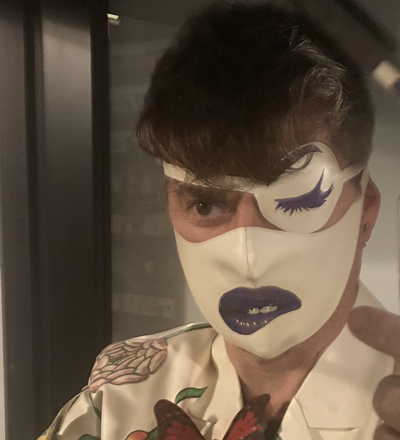
Rachel Redfern saves me! Redemption! Thank God; she asks me about my suit. Phew! A reprieve.
[to be continued, rhizomatically...]
A Weirdo: Footnotes
1. In Edgar Allan Poe’s The Oval Portrait, the narrator describes how the vignetting of the ‘life-likeliness’ of the woman’s ‘head and shoulders’ ‘melted imperceptibly into the vague yet deep shadow which formed the background of the whole’, and how he was startled, ‘confounded, subdued, and appalled’ by the effect. The editor, G. R. Thompson explains that the ‘vignette manner’ is ‘an art technique to soften the edges of the picture so that it shades off into the borders of the frames, blurring the distinction between picture and frame.’ In brief, the narrator, sees the life-like disembodied head of a beautiful woman floating in the niche of the room. The distinction between the merging of inner and outer frame relates to my inability to distinguish between the proxemics of the ‘near’ and ‘far’ placement of ethereally floating bodies in space when I’m dancing. Occasionally, I look up and get startled. That’s it!
Poe is, of course, brilliant because the tale is a frame narrative where one linguistic frame melts into another, the text mirroring the object of representation. If you have not have read the earlier version which has a longer frame narrative, describing the narrator’s ‘fever’, ‘delirium’ and a dose of ‘solid opium’ he takes. do have a read. See Edgar Allan Poe, The Selected Writings of Edgar Allan Poe, ed. G.R. Thompson (Norton: New York, 2004), pp. 295-299.
I must, at some juncture, tell you story about the connection between Poe’s The Oval Portrait, my encounter with a young woman at Torture Garden at Scala in April, meeting Jeremy Paxman in The London Library, and a fond moment between my two childhood lap dogs, Bates and Splat. [Return to text]
2. ----- ---, quite rightly, verbally plays upon an important distinction between the definite article 'the', and the indefinite article 'a'. The whole situation, viewed from a different angle of politeness reveals that ----- --- is actually being very polite. By not taking credit for being the ‘only’ fetish model in the industry she’s not only being humble but also showing good grace to the achievements of all of the other fetish models. [Return to text]
3. Mark Fisher's wonderful book, The Weird and the Eerie, discusses the 'weird' as 'that which does not belong' and the form of its expression as 'the conjoining of two or more things which do not belong together', see The Weird and the Eerie (Repeater: London, 2016), pp. 10-11. His essays make great advances beyond Freud's essay on 'The Uncanny', discussing a range of literary texts, films and rock bands, such as The Fall.
Mark Fisher blogged under the name 'k-punk', and his essays on music, film, theory and politics, were finally collected and published together after his suicide; see K-PUNK: The Collected and Unpublished Writings of Mark Fisher, ed. Darren Ambrose, (Repeater: London, 2018).
Goldsmiths University of London now hold an annual Mark Fisher Memorial Lecture in his honour, and I attended, with Emmeline May, the lecture given by his friend, and another post-punk aficionado, Simon Reynolds, author of the exhilarating Rip it Up and Start Again: postpunk 1978-1984 (Faber and Faber: London, 2005), which might be my favourite non-fiction book of all time. The lecture hall was so packed, Goldsmiths had to provide attendees with three overflow rooms.
Isn't it fantastic to see that three of Mark Fisher's students launched a club night in the honour of their teacher? See: https://www.huckmag.com/art-and-culture/why-we-started-a-club-night-for-our-teacher-mark-fisher/
4. T.S. Eliot, ‘The Love Song of J. Alfred Prufrock’, from The Poems of T.S. Eliot, eds. Christopher Ricks and Jim McCue (Faber and Faber: London, 2015), pp. 5-9. [Return to text]
Comments